
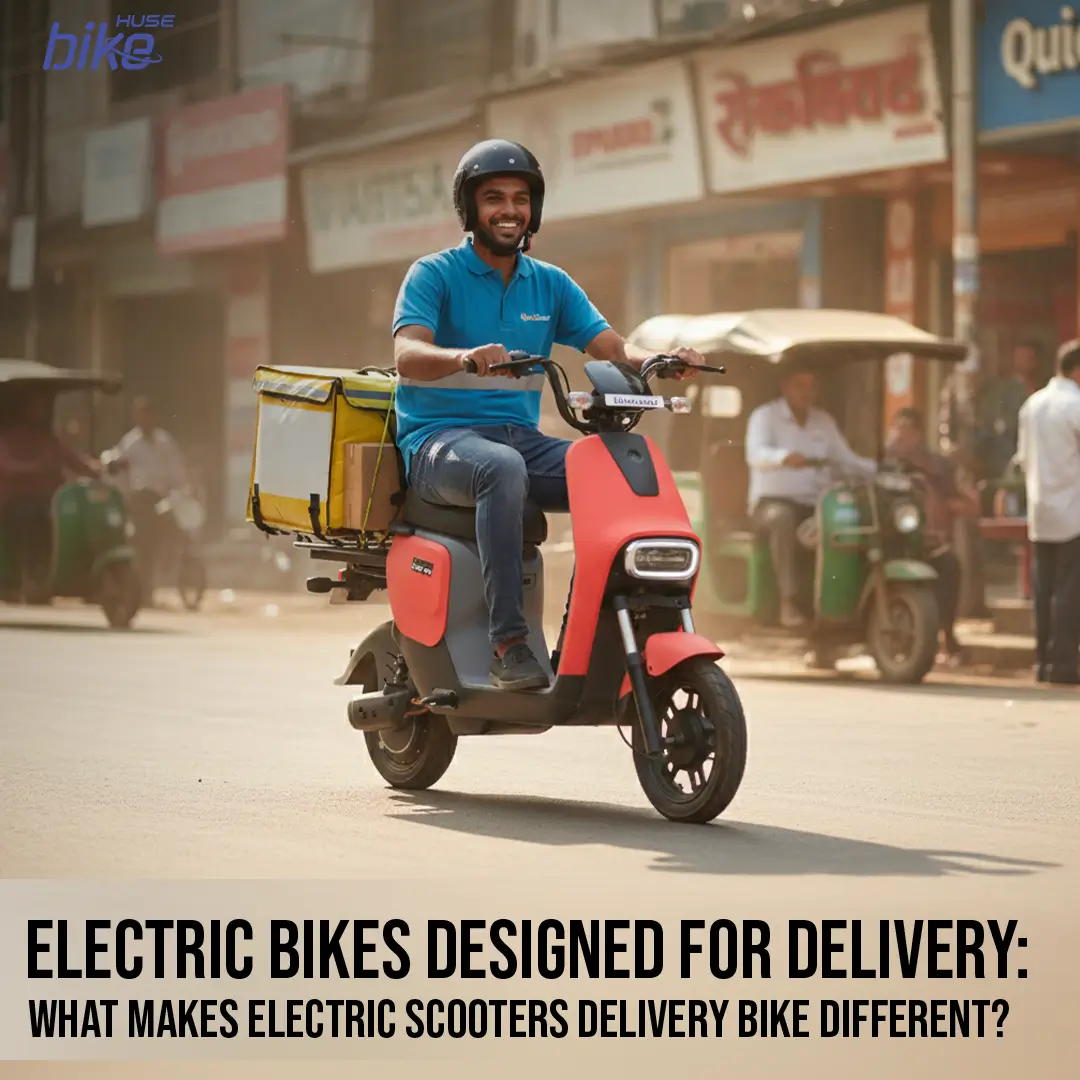
If you spend five minutes on any busy street in Delhi, Bangalore, or Mumbai, you’ll see the same thing: a sea of scooters weaving through traffic with big, heavy bags strapped to the back. Most of these are just regular petrol Activas or Pulsars that weren’t really built to carry a week’s worth of groceries or three hot pizzas at 40 degrees Celsius.
But things are changing fast. If you’re a delivery partner or you run a small logistics fleet, you’ve probably looked at an electric scooter delivery bike and wondered if it’s any different from the ones people use to go to college. The short answer? It must be. A delivery bike isn’t a toy; it’s a tool. If it breaks, you don’t just miss a ride, you lose a day’s wages.
Let’s talk about what makes a delivery-grade electric scooter different from the stuff you see in fancy showrooms.
The Frame: It’s About Heavy Lifting in an Electric Scooter Delivery Bike
A standard electric scooter is built for one or two people and maybe a bag of vegetables. But an electric scooter for delivery is basically a pack mule.
When you strap a 20kg or 30kg box to the back of a normal scooter, the frame starts to flex. Over time, the metal gets tired, and things start to rattle. Delivery-specific bikes, like the ones we’re seeing from Huse Bike, use reinforced single-tube or dual-tube frames with fewer welds. Fewer welds mean fewer places for the bike to snap under pressure.
When you strap a 20kg or 30kg box to the back of a normal scooter, the frame starts to flex. Over time, the metal gets tired, and things start to rattle. Delivery-specific bikes, like the ones we’re seeing from Huse Bike, use reinforced single-tube or dual-tube frames with fewer welds. Fewer welds mean fewer places for the bike to snap under pressure.
At Huse, our “Slick” series is designed with a 120kg payload capacity. That’s not just a random number; it’s the difference between a bike that stays stable when you’re carrying a heavy load and one that wobbles every time you take a turn.
Suspension and Tires: Handling the Pothole Test in Electric Scooter Delivery Bike
Indian roads don’t care about your delivery schedule. You’re going to hit potholes, speed bumps, and loose gravel.
➤ Dual Suspension:
A delivery bike needs “quadruple” shock absorption, meaning both the front and rear need to handle the bounce. If the suspension is too soft, the bike bottoms out with a heavy bag. If it’s too stiff, the rider’s back is going to be ruined by the end of an 8-hour shift.
➤ Tires
You want thicker, 10-inch or 12-inch pneumatic tires. They grip the road better in the rain and absorb the vibration so the food (or the electronics) you’re carrying doesn’t get rattled to pieces.
The Battery Reality: Range vs. Downtime in Electric Scooter Delivery Bike
This is where the real “human” problem happens. If you’re doing an electric scooter for delivery in India, you can’t afford to spend 5 hours sitting next to a plug in the middle of a lunch rush.
In 2026, tech has moved toward two things: Range and Swapping.
➤ The 70km Sweet Spot:
For a local delivery area, a 70km range (like on the Huse Slick+) is usually enough for a solid shift.
➤ Battery Management (BMS):
It’s not just about how big the battery is; it’s about how it handles the heat. Indian summers can bake a battery. A good delivery bike has an “explosion-proof” lithium battery with a smart BMS that keeps the cells cool even when you’re pushing the motor hard.
The Money Talk: Why Petrol is Dying in 2026 and the Rise of Electric Scooter Delivery Bike
Let’s be real, the only reason anyone switches to electric is math. In 2026, petrol is hovering around ₹100-105 per litre. If you’re riding 60-80km a day, you’re burning roughly ₹150-200 just on fuel.
➤ Petrol Cost:
~₹2.50 to ₹3.50 per km (including oil changes and service).
➤ Electric Cost:
~₹0.30 to ₹0.50 per km.
Over a month, that’s a saving of nearly ₹5,000 to ₹7,000. For a delivery partner, that’s a massive pay raise just by changing the machine you ride. Plus, there’s no engine oil, no spark plugs, and no gears to mess up. You basically just check the brakes and the tires.
Why Slow and Steady Wins for Business with Electric Scooter Delivery Bikes?
You’ll notice that many delivery bikes, including the Huse Bike Slick models, are capped at 25 km/h. Why?
➤ No License/Registration:
In India, these “low-speed” EVs don’t require a driving license or RTO registration. This is huge for businesses that want to hire riders quickly without the paperwork headache.
➤ Safety:
In heavy city traffic, you’re rarely going faster than 20-25 km/h anyway. The lower speed keeps the rider safe and ensures the battery lasts the whole day.
Dealing with the Indian Monsoon: Tips for Electric Scooter Delivery Bike
If you’ve ever ridden in a Mumbai or Bangalore downpour, you know that water is the enemy of electronics. A real electric scooter delivery bike needs an IP67-rated motor and battery. This means you can ride through puddles without the bike turning into a very expensive paperweight. At Huse, we focus on selling the motor and the drum brakes, so they keep working even when the roads look like rivers.
Conclusion
At the end of the day, an electric scooter for delivery in India is a business investment. If you buy a cheap, “recreational” scooter for a delivery job, you’ll save money today and spend it all on repairs next month
A real delivery bike needs: a frame that doesn’t grind under a 120kg load; breaks that stop when the bike is heavy (drum brakes are often better here because they last longer) and a battery that doesn’t quit when the sun is beating down.
At Huse Bike, we don’t build these to look pretty in a mall. We build them to work. Whether it’s the Slick+ for the long shifts or the H2O for the quick hyperlocal runs, the focus is on keeping you on the road and putting more money in your pocket at the end of the day.
Are you ready to stop donating your earnings to the petrol pump? Math is simple, and the tech is ready. If you’re looking to upgrade your delivery game, come check out the Huse Bike range. We’ve designed these specifically for the hustle of Indian streets.